Church of St. Ignatius of Loyola: Where Heaven Meets Art
The Church of St. Ignatius of Loyola is not only a place of worship, but a real theatrical stage where painting becomes illusion, deceiving the eye and the mind. As you cross the threshold, prepare to look up to admire a ceiling that knows no bounds, a masterpiece of perspective that will make you believe you're seeing paradise unfold above you.
☰ Table of Contents
Church of St. Ignatius of Loyola – Visiting Hours and Mass
You want visit it without disturbingHere's everything you need to know to enjoy the masterpiece while respecting religious functions.
Opening Hours of Sant'Ignazio di Loyola
Open every day from 9:00 to 23:30
Please note: Entrance to all areas is completely free.
Mass times
- Everyday: 18:30
- Sundays and holidays: 11:30, 18:30
There is a famous mirror that allows you to admire (and illuminate) the vault of the church. To use it you need to pay a small fee (1€)
Guided and Special Tours of Hidden Rome
If you are looking for a more intimate and in-depth experience, there are special tours that focus on art, the history of the Jesuits and the secrets of the fake dome
Architecture and details of St. Ignatius of Loyola
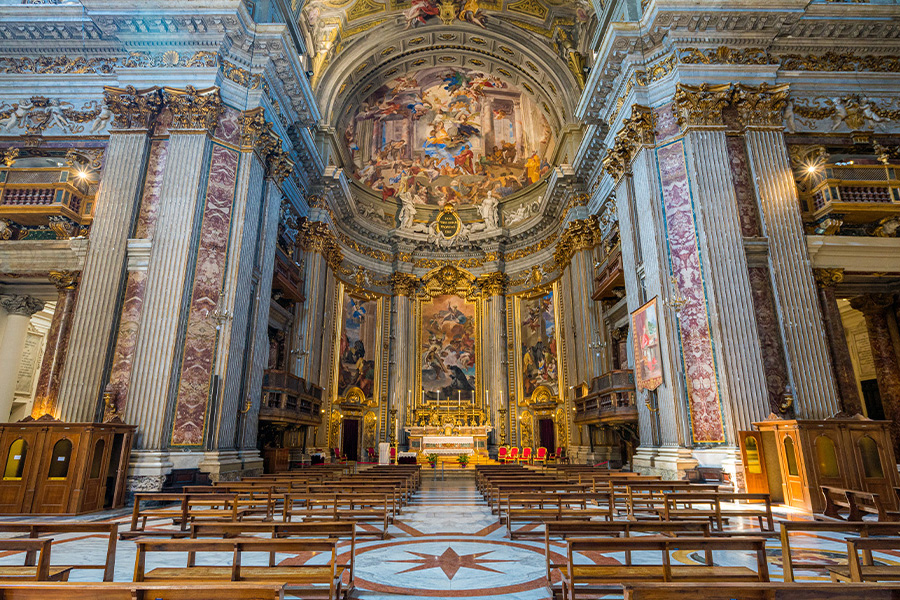
The church follows the typical model of the large Jesuit churches: it has a Latin cross plan, with a single, wide nave and a series of side chapels which open onto it. This structure was designed to accommodate large crowds of worshippers and to focus attention on the high altar and, above all, the magnificent ceiling above it.
The absence of a true dome over the intersection of the nave and transept is one of the church's most fascinating stories. Due to a lack of funds, the dome was never built. But instead of leaving the space empty, the brilliant Jesuit artist Andrea Pozzo painted a fake dome on a flat canvas 17 meters in diameter. The result is an optical illusion so perfect that it fools anyone into thinking they're looking at a real dome. To best appreciate the effect, look for the yellow marble disk on the floor of the nave: it's the exact spot where the illusion works perfectly.
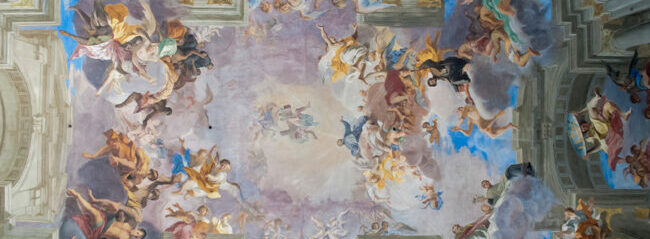
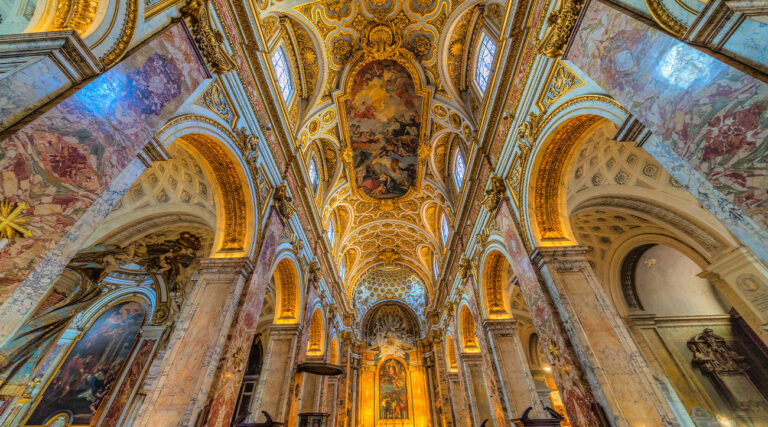
The absolute masterpiece of the church is the monumental fresco on the ceiling of the nave, also the work of Andrea PozzoThe work, entitled "The Apotheosis of St. Ignatius," is an intoxicating celebration of the founder of the Jesuit order. The artist used the technique of trompe-l'oeil To create the illusion that the ceiling opens up to the sky, with celestial figures, angels, and saints moving toward paradise in an explosion of light and color. The painted architecture seems to continue the real one, uniting painting and architecture in a single, glorious vision.
Let yourself be captivated by the notes of Vivaldi, Verdi and Puccini in extraordinary locations such as baroque churches and historic theatres.
Did you know that...?
The “fake” dome: To admire the optical illusion of the dome, you need to be in a specific spot. Look for the yellow marble disk on the floor of the central nave: from there, the perspective is perfect, and the illusion works perfectly.
The “jack of all trades” artist: the author of the frescoed ceiling, Andrea Pozzo, was a Jesuit and a true genius of the Baroque. He was not only a painter, but also an architect and a theoretician of perspective, whose works influenced artists throughout Europe.
The Pope's tomb: the church houses the tomb of Pope Gregory XV, born Alessandro Ludovisi. He is buried in the family chapel, making the site an important papal burial site.
The detail that enchants
When you look up, the fresco, entitled “The Apotheosis of Saint Ignatius”, gives the illusion that the ceiling no longer exists, opening the church to the heavens. Angelic figures and saints float in an explosion of light and perspective. The painted architecture seems to continue the real one, uniting the walls and ceiling in a single, glorious vision.
Not to be missed in Sant'Ignazio di Loyola
Plan your visit to St. Ignatius of Loyola
Recommended duration
A visit to the Basilica can keep you busy about 40 minutes
Best times
Having been heavily publicized by travel bloggers, the church gets a lot of visitors during peak hours. Avoid them
Accessibility
The Basilica is accessible via platform
Special itineraries and guided tours
They are proposed sporadically, free guided tours by a volunteer association
Tours and guided visits to hidden Rome
To fully understand every detail and the genius behind his illusions, a guided tour is the ideal solution.
Useful information for your visit
- 06 6794406
- Via del Caravita 8/A 00186 Rome
- Average visit duration approximately 40 minutes
- Accessibility for visitors with reduced mobility
- Open every day, according to the opening hours
Insider tips
- To enjoy the optical illusion without the crowds, visit the church early in the morning or late in the afternoon.
- The ceiling fresco was designed to interact with natural light. Visit it in the sunshine.
- Before you get in line, know that you will have to pay €1 to see the frescoes from the mirror.
How to get to Sant'Ignazio di Loyola
The Church of Sant'Ignazio di Loyola is located in the historic center of Rome, a stone's throw from Piazza di Pietra, easily accessible on foot or by public transport.
The nearest metro stop is Barberini (Line A). From the station, walk for about 15 minutes following the signs for the Pantheon and Piazza Sant'Ignazio. You'll pass the Trevi Fountain!
Several buses pass nearby, stopping at strategic points such as Via del Corso or Piazza Venezia. The most convenient lines are the 40, The 64, The 70, the85, the87 and the 492The church is just a short walk from these stops.
There are no tram lines that go directly to the church. The nearest tram stop is Piazza Venezia (Line 8), which is about a 10-minute walk from the church.
Arriving by car is strongly discouraged The Church of Sant'Ignazio is located within the Limited Traffic Zone (ZTL) of Rome's historic center. The ZTL's operating hours vary, but access is still limited. I recommend using public transportation or finding paid parking outside the ZTL and continuing on foot.
Given its central location, walking is the best option for those who are already in the center. From Termini StationThe church is about 2.4 km away (about a 25-30 minute walk), a route that will allow you to admire many other monuments and places of interest along the way.
Address of the Church of St. Ignatius of Loyola
Official Transport Rome
Helpful Advice
To fully enjoy the masterpiece that is the Church of Sant'Ignazio, don't just look and take a photo. Choose a moment of calm, preferably during the week or in the late afternoon.
History of the Church of St. Ignatius of Loyola
The birth of the Church
The history of the Church of St. Ignatius of Loyola is not just the history of a building, but the story of the power and vision of one of the most influential religious orders in history: the Society of JesusFounded by Saint Ignatius of Loyola in 1540, the Jesuit order quickly became a pillar of the Counter-Reformation, dedicated to education, evangelical mission, and preaching. In the heart of Rome, the Jesuits established their center of power and study: the Roman College, a prestigious educational institution with thousands of students and professors. The growing number of faithful and students necessitated the construction of a church that could serve the enormous community, and in 1626, Cardinal Ludovico Ludovisi, nephew of Pope Gregory XV, laid the cornerstone.
Read allShow less
Read allShow less
The initial design was entrusted to Jesuit architect Orazio Grassi, who took inspiration from the nearby monumental Church of the Gesù, the order's motherhouse. The Latin cross plan, with a single, wide nave and side chapels, reflected the Jesuit philosophy: to create an open, majestic, and welcoming space, ideal for preaching and for accommodating large crowds of worshippers. Construction of the masonry proceeded rapidly, but the completion of the interior, particularly the dome and ceiling, required a solution that was not only artistic, but also financial.
The realization and genius of Andrea Pozzo
As the structure of the church took shape, a financial problem arose: the lack of funds to build a real domeAt this point, the visionary genius of Andrea Pozzo (1642-1709) entered the scene, a Jesuit brother who was not only a painter, but also an architect, a decorator, and a master of perspective. His mission was not just to paint, but to solve an architectural problem through the deception of art.
Pozzo was a profound scholar of the theories of perspective, so much so that he wrote one of the most important treatises on the subject, Perspectiva pictorum et architectorum (The Perspective of Painters and Architects). His skill lay in creating optical illusions that fused painting with real architecture, pushing the limits of the visible. For the Church of Sant'Ignazio, his project was bold: he would have painted the glorious apotheosis of the saint on the ceiling of the nave and, where the dome should have been, it would create an illusion so perfect that it would deceive the eye of every spectator. The result was a masterpiece of trompe-l'oeil which transformed an economic problem into one of Rome's most famous artistic attractions.
The pictorial masterpiece: the Apotheosis of Saint Ignatius
The artistic highlight of the church is undoubtedly the monumental fresco on the ceiling of the nave, entitled "The Apotheosis of St. Ignatius". It is a work of colossal dimensions which seems to dissolve the ceiling itself. The eye is immediately drawn to a luminous central figure, which represents St. Ignatius ascending to heaven, welcomed by the Trinity. Around him, angels, saints, and allegorical figures move in a vortex of light and shadow.
But Pozzo's genius lies in the details. The fresco it is not a simple painting, but an extension of the underlying architectureThe painted columns and arches appear to continue the actual structures of the church, creating an illusion of depth that seems to rise to infinity. In the four vaults radiating from the center, Pozzo painted figures symbolizing the four known continents at the time: Europe, Asia, Africa, and America.
This was no coincidence, but a powerful statement of the Jesuits' global mission. The work is rich in symbolism, from the light emanating from Christ's body, illuminating St. Ignatius, to the clouds and angels creating a dramatic, theatrical setting, typical of Baroque art. It is a celebration not only of a saint, but of the entire Society of Jesus and its members. ambition to evangelize the world.
The fake dome: the triumph of illusion
The most striking and iconic element of the church is its false dome. As mentioned, due to financial constraints, the dome planned for the intersection of the nave and the transept was never built. But Andrea Pozzo accepted the challenge. On a flat canvas 17 meters in diameter, he painted an architecture in perfect perspective that simulated a real domeThe illusion is so convincing that the visitor's eye, accustomed to seeing three-dimensional architecture, is completely deceived.
For the illusion to work, the visitor needs to be in a specific spot. Pozzo marked this spot with a yellow marble disc on the floor of the nave. From there, the perspective lines align perfectly, creating a three-dimensional image. If you move just a step, the illusion breaks, and you can see the painting as a flat, distorted canvas. This isn't just a curiosity, but a key element of Pozzo's philosophy: art isn't just something to look at, but something to interact with. The fake dome is the perfect example of how ingenious art can solve a practical problem with an aesthetic solution, transforming an architectural failure into a pictorial triumph.
The next story: restoration, conservation and the artistic legacy
After the church's completion, Andrea Pozzo's work immediately became famous throughout Europe. His illusion and perspective techniques were copied and imitated in countless other churches and palaces. However, the fresco, exposed to the elements and candle smoke, gradually deteriorated. Over the centuries, several restorations have been carried out to preserve its beautyThe most significant interventions were those of 1963 and 1993, which brought the original colors back to light and stabilized the painted surface.
In addition to its artistic value, the Church of Sant'Ignazio is also a place of profound historical importance. Inside, the tombs of illustrious figures are found here, such as that of Pope Gregory XV and his nephew, Cardinal Ludovico Ludovisi, whose financial contributions made the church's construction possible. The presence of these tombs and the richly decorated side chapels testifies to the power and wealth of the families who supported the Jesuit order and the Counter-Reformation. The church is not just a museum, but a living place, continuing to celebrate faith, art, and history in a single, fascinating experience.
The symbolic meaning: between art and spirituality
The Church of Saint Ignatius of Loyola is the perfect expression of the union between Baroque art and Jesuit spiritualityThe order used art strategically to engage the faithful, to make them participate in the drama of faith, and to elevate the soul. Pozzo's illusions were not simple tricks; they were tools to inspire awe and wonder, to allow the divine greatness to be perceived in a new and sensorial way. The ceiling was not just a work of art, but a metaphor for paradise opening up to the faithful, inviting them to look beyond earthly reality.
Today, the church continues to play this role. Millions of people come in and look up, gazing awestruck by a nearly 400-year-old illusion. Its legacy is a reminder that true beauty lies not merely in form, but in a work of art's ability to touch the heart and the imagination. The Church of Sant'Ignazio is an enduring testament to the power of art to transcend its physical limitations and offer a vision of the divine.
Historical curiosities
A crypt under the churchBeneath the church's main altar is a crypt that is not open to the public. This space, built of brick and featuring a simple architecture, bears witness to the early stages of the church's construction.
The missing statueOriginally, the church's façade was supposed to feature statues of Saint Ignatius and Saint Francis Xavier. Due to lack of funds, they were never built, leaving the niches empty.
The bell towerThe Church of Saint Ignatius of Loyola does not have a true bell tower. The bells are housed in a small, almost hidden, gabled structure on the roof, an unusual choice for such an imposing church.
Saint Ignatius of Loyola in brief:
Baroque masterpiece: The church is one of the most important examples of Baroque art in Rome, known for its grandeur and bold optical illusions.
The genius of Andrea Pozzo: the Jesuit artist Andrea Pozzo He is the author of the magnificent fresco on the ceiling, which creates the illusion of an opening towards the sky with a perfect perspective technique.
The fake dome: Due to a lack of funds, the church lacks a dome. Pozzo solved the problem by painting one on a flat canvas, creating an illusion so convincing it's an attraction in itself.
Symbol of Jesuit spirituality: Church art is not just decoration, but a tool to elevate the spirits of the faithful, offering a vision of the divine that engages them in an emotional and sensorial way.
- Year of construction: the first stone was laid in 1626.
Frequently Asked Questions
What can you see in the Church of St. Ignatius of Loyola?
You can admire the frescoed vault, the false dome, the tomb of St. Ignatius and that of Gregory XV. All works by Andrea Pozzo.
What are the Mass times at San Sebastiano Fuori le Mura?
Masses are celebrated every day at 6:30 pm and on holidays also at 11:30 am.
What important things did Saint Ignatius do?
Ignatius of Loyola, born Íñigo López de Loyola or Eneko Lopez Loiolakoa in Basque (Loyola, 1491 – Rome, 31 July 1556), was a Spanish religious and military man, founder of the Society of Jesus.
What is the purpose of the mirror in the church of Sant'Ignazio?
It's used to illuminate and comfortably observe the frescoed vault. Its use costs €1.
Where is the tomb of St. Ignatius of Loyola located?
His tomb is located at the right side altar of the church of Sant'Ignazio, work by Andrea Pozzo.
Photo gallery of Saint Ignatius of Loyola
What to see near Sant'Ignazio di Loyola
Where to eat near Sant'Ignazio di Loyola
After so much wonder, the area around the church offers lots of options for a tasty break, from historic cafes to typical restaurants.
Typical Roman trattorias
- Golden Ravioli
Rustic restaurant, homemade first courses. - Ancient Stone Inn
Traditional cuisine, view of the square. - The Barroccio Roma
Typical dishes, welcoming atmosphere. - Hosteria de' Pastini
Roman cuisine, historic location.
Restaurants
The Temple Inn
Italian cuisine, gluten-free dishes.The ingenious sandwich
Gourmet sandwiches, creative street food.Achilles at the Pantheon
Friendly atmosphere, fair prices.- Anthony at the Pantheon
Historic tavern, generous portions.
Pizzerias
- The Sacristy
Roman pizza, historic setting. - Pizza and mozzarella
Classic pizza and Lazio specialties. - Pizza and sandwiches
Artisan sandwiches, pizza by the slice. - From Cicero
Roman tradition, home-cooked flavors.
Map of restaurants near Sant'Ignazio di Loyola
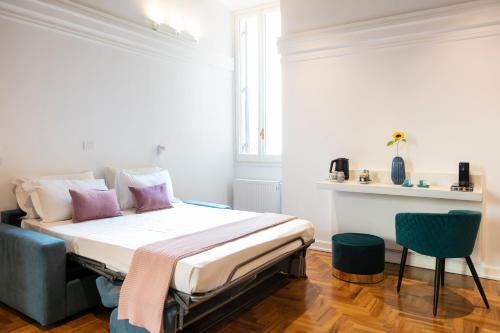
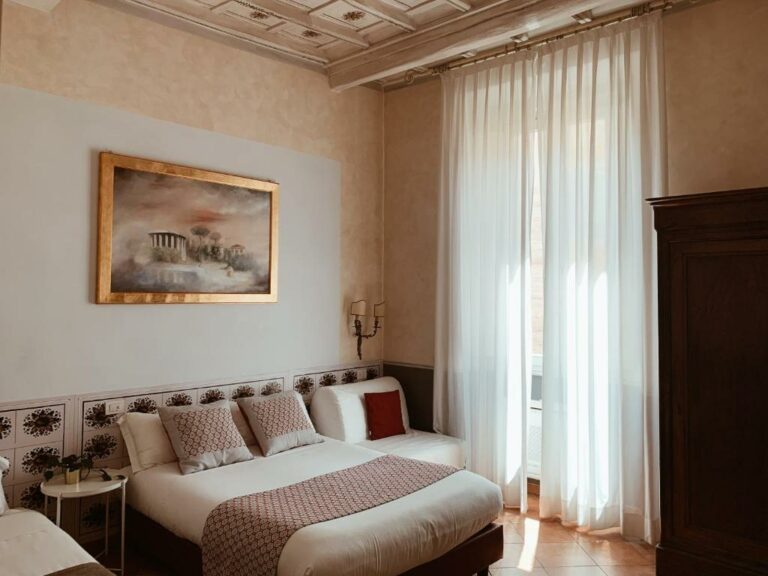
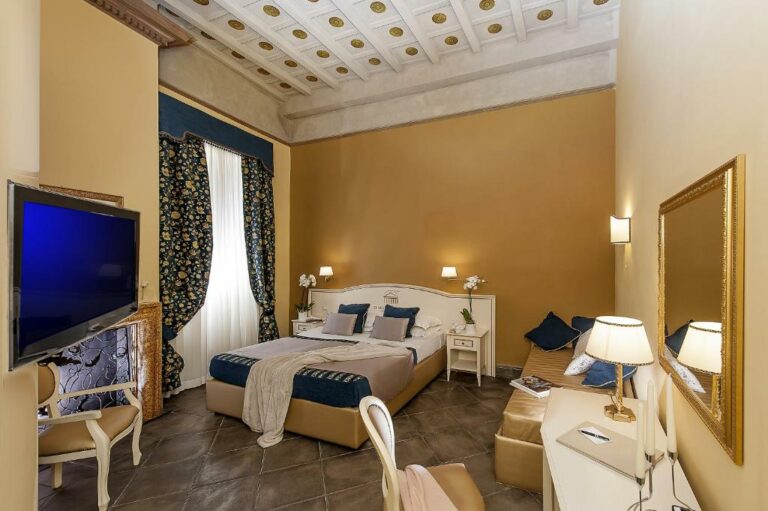
Where to stay near Sant'Ignazio di Loyola
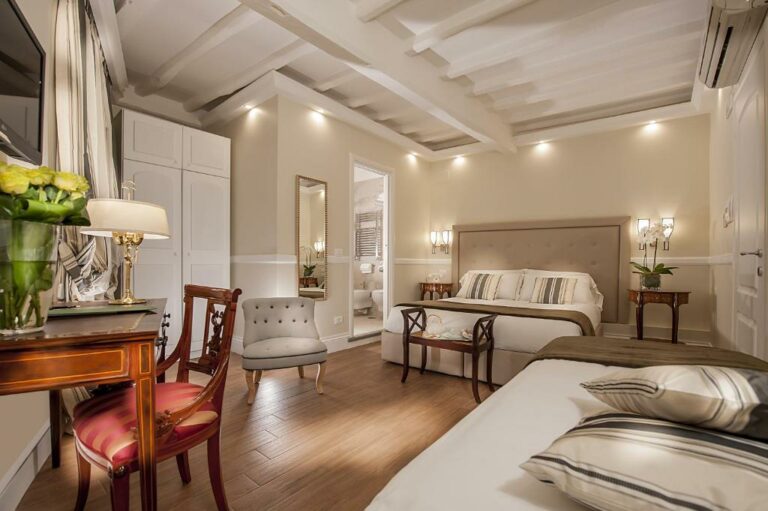
If you want to immerse yourself in the history of Rome on foot, staying in this area is the perfect choice for you. experience the city like a true RomanYou can find alternatives nearby near the Pantheon or of Piazza Navona.